

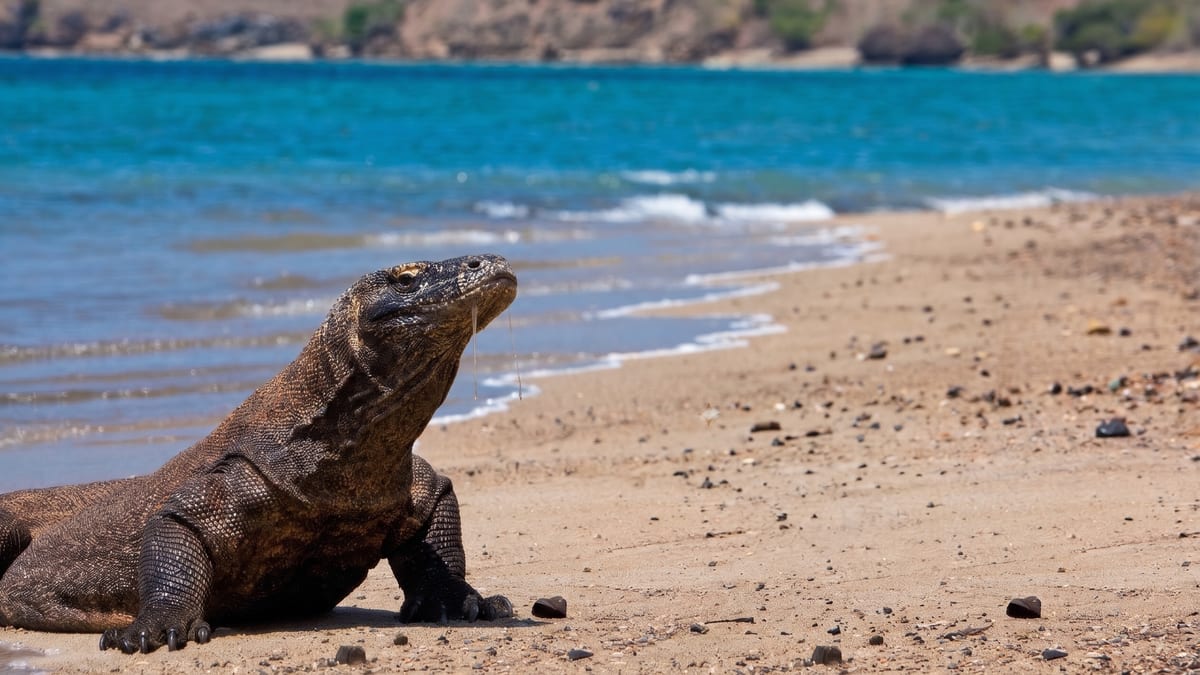
History and Discovery of the Komodo Dragon
For centuries, rumors of giant "land crocodiles" inhabiting remote islands in the Lesser Sunda chain circulated among sailors and pearl divers. However, the outside world did not officially document this species until 1910, when Lieutenant Jacques Karel Henri van Steyn van Hensbroek, a Dutch colonial administrative official, heard tales of the giant reptile on Komodo Island.
In 1912, Peter Ouwens, Director of the Zoological Museum in Bogor, West Java, published the first official scientific description of the species after receiving skin specimens and photographs from van Steyn van Hensbroek. This discovery instantly sparked international interest—even inspiring the 1933 classic film, King Kong. Recognizing the immense ecological value of this ancient reptile and its vulnerable habitat, the Indonesian government established Komodo National Park in 1980, which was later designated as a *UNESCO World Heritage Site* in 1991.
Physical Characteristics: Designed for Survival
Adult Komodo dragons are exceptionally resilient creatures, typically growing up to 3 meters in length and weighing between 70 and 90 kilograms in the wild. Their muscular bodies are covered in hard, armored scales reinforced with small bones called osteoderms, which act like natural chain mail during territorial battles.
Key physical traits of the Komodo dragon include:
Sharp Sense of Sight and Smell: Although their vision and hearing are relatively average, Komodo dragons rely on their long, yellow, forked tongues to "taste" the air. By transferring scent particles from the air to Jacobson's organ on the roof of their mouths, they can detect carrion from a distance of 4 to 9.5 kilometers.
Serrated Teeth and Deadly Venom: Their jaws are lined with approximately 60 sharp, serrated teeth designed to tear flesh. In addition to saliva rich in bacteria, research has proven that Komodo dragons possess venom glands that secrete toxins to induce massive bleeding, shock, and paralysis in their prey.
Powerful Tail: Their thick, muscular tail is nearly as long as their body. It serves as a counterbalance when running—reaching speeds of up to 20 km/h over short distances—while also acting as a deadly weapon to subdue opponents.
Behavior, Diet, and Reproduction
Komodo dragons are solitary and extremely patient ambush predators. Unlike hunters that actively chase prey, they often lie motionless along animal trails, waiting for deer, wild boar, water buffalo, or smaller reptiles to pass by. Once a Komodo attacks, its powerful bite severely wounds the prey, and the dragon calmly follows the animal until it weakens and collapses.
Despite their fearsome reputation as apex predators, a Komodo dragon's life cycle begins in a highly vulnerable state. Females lay about 20 eggs in underground burrows or abandoned megapode nests. When the hatchlings emerge after approximately eight months, they immediately climb trees. For the first few years of their lives, young dragons live in the trees, feeding on insects, geckos, and small birds to avoid the threat of being eaten by cannibalistic adults on the ground.
Habitat and Current Conservation
Wild Komodo dragons are endemic animals inhabiting only a tiny corner of the world—exclusively on *Komodo Island*, Rinca, Flores, Gili Motang, and Nusa Kode in East Nusa Tenggara Province. They survive in tropical savanna forests and dry coastal grasslands, coping with scorching daytime temperatures by sheltering in self-dug burrows at night.
Currently, the Komodo dragon is listed as Endangered on the IUCN Red List. The species faces continuous threats from habitat loss, poaching of its primary prey, and rising sea levels due to climate change. Strict conservation efforts within *Komodo National Park*—combined with responsible ecotourism management—are the key to ensuring that Indonesia's proud ancient "dragon" thrives for generations to come.